7 Tips to Choose Wall Clock Parts for Global Buyers?
Choosing Wall Clock Parts for international markets involves more than matching a movement with a dial. Buyers must assess accuracy, shaft length, hand compatibility, power requirements, packaging, compliance, and after-sales support. A quiet bedroom clock needs different specifications from a large retail display. Small mismatches can create returns, delays, and damaged brand trust.
Market evidence supports a careful approach. Grand View Research’s wall clock market analysis identifies growing demand for decorative, smart, and customized timepieces across residential and commercial applications. Meanwhile, the International Trade Centre highlights the importance of product standards, customs documentation, and reliable cross-border supply chains in global trade. These findings suggest that component selection should consider the complete buying environment, not only unit price. The cheapest mechanism may become expensive after freight, inspection, and replacement costs.
This guide presents seven practical tips for global buyers. It examines movement torque, hand dimensions, battery performance, noise ratings, material quality, packaging protection, and supplier verification. ISO 9001 quality-management principles also provide a useful reference when evaluating manufacturing consistency and corrective-action records. However, certifications alone do not guarantee a perfect shipment. Samples still need testing. Assumptions can fail.
A professional buyer should measure the dial thickness, check the rear clearance, and run the movement continuously before approval. Regional voltage, battery availability, climate, and labeling rules also deserve attention. These details may appear minor. They are not. The right Wall Clock Parts should perform reliably, fit precisely, and remain commercially practical from factory to final customer.
Define the Seven-Part Buying Checklist with a ±20-Second Monthly Accuracy Target
7 Tips to Choose Wall Clock Parts for Global Buyers
Define the Seven-Part Buying Checklist with a ±20-Second Monthly Accuracy Target
A reliable wall clock begins with seven checks: movement, oscillator, hands, dial fit, battery contact, case mounting, and supplier documentation. The movement should support a tested accuracy of ±20 seconds per month. Ask for test conditions, not only catalog claims. Temperature, battery voltage, and hand weight can change results. A 30-day sample test is more useful than a short factory demonstration.
Check shaft length against dial thickness. Loose hands may create visible drift. Inspect gear noise, contact pressure, and mounting threads. Battery contacts should resist corrosion during humid transport. Packaging also matters. The Global E-waste Monitor 2024 reports 62 million tonnes of electronic waste generated in 2022. Durable parts and replaceable movements can reduce avoidable disposal. This is practical sustainability, not decorative language.
Supplier evidence completes the checklist. Request tolerance records, incoming inspection rules, material declarations, and batch traceability. The Circularity Gap Report 2024 measured global circularity at only 7.2 percent. Repair-friendly construction deserves more attention. Still, a perfect specification can fail in real assembly. Review pilot samples across several production batches. Compare monthly timing against a reference clock, and record every adjustment. The ±20-second target is achievable, but only when testing becomes part of purchasing.
Match Movement Torque to Hand Weight Using Manufacturer-Rated mN·m Limits
When global buyers select wall clock parts, movement torque deserves close attention. The movement must lift the complete hand set, not only the minute hand. Measure each hand’s weight and length before ordering samples. Small details matter. A long brass-style hand can create more resistance than its weight suggests. Torque depends on force and distance from the pivot. Dust, friction, and a tight dial hole can increase the actual load. These conditions are often missed during catalog selection.
Use the manufacturer-rated torque limit in mN·m as your working reference. Compare it with the torque required by the heaviest compatible hand position. Do not treat the published value as an automatic safety margin. A movement rated at 2.0 mN·m may perform poorly near that limit. Leave practical headroom for battery decline, temperature changes, and assembly variation. For a sample test, install the final hands and dial, then observe several cycles. Check for stopping, delayed movement, or uneven stepping. Record the battery type and hand dimensions.
Ask the supplier how torque was measured and at what voltage. This question improves traceability across factories and markets. Request drawings, tolerance data, and written compatibility guidance. I have learned that “fits the shaft” does not mean “runs reliably.” That distinction can be costly. A conservative selection may look oversized, yet it often reduces returns and field complaints. Still, recheck the design when changing hand materials or lengths. My own review process is not perfect, especially when decorative hands vary between batches. That weakness deserves documentation, not guesswork.
Select Hands, Dials, and Shafts by Size, Balance, and Compatibility Data
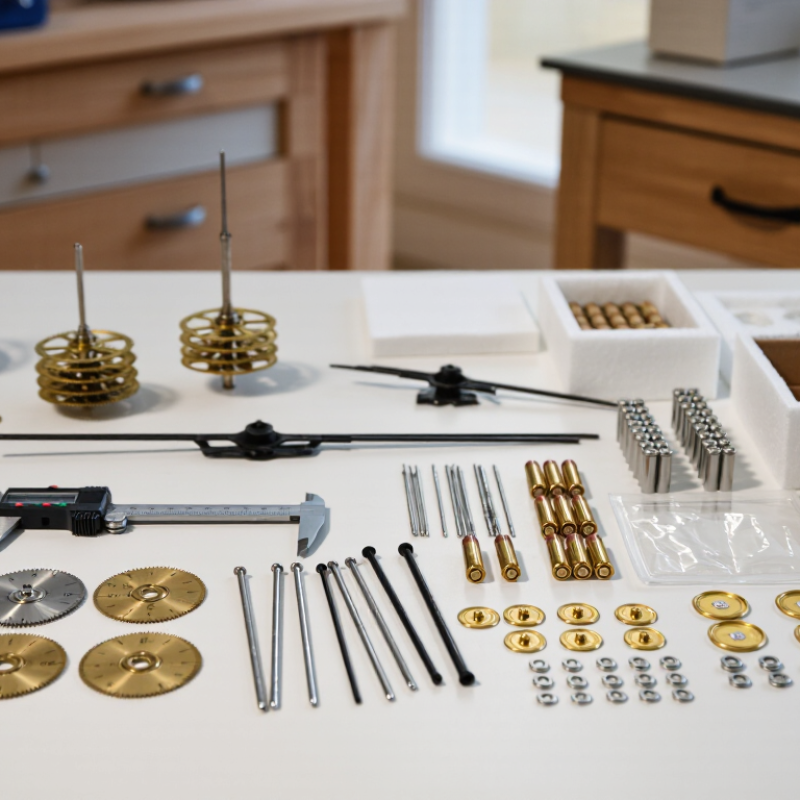
Choosing wall clock parts for global markets requires more than matching a visual style. Start with the dial diameter and hand length. The minute hand should remain inside the dial edge, usually leaving a visible clearance of 2–4 millimeters. Measure from the shaft center, not the hand’s total length. Small errors can create rubbing, uneven movement, or poor readability.
Shaft selection needs precise compatibility data. Record the movement’s shaft length, thread diameter, nut size, and mounting-hole position. Metric drawings reduce confusion across markets. ISO 286-1:2010 provides a useful framework for dimensional tolerances, but clock suppliers should still request actual movement drawings. Check the movement’s torque rating against the total hand weight. A long metal hand may look elegant, yet it can overload a small mechanism. Balance matters. I have seen hands rotate correctly during testing, then stop after vertical installation.
Sustainability also affects part selection. The Global E-waste Monitor 2024 reported 62 million tonnes of electronic waste in 2022, with only 22.3% formally collected and recycled. Replaceable hands, dials, and movements can extend product life, but only when sizes remain documented. Buyers should request sample assemblies, clearance photos, tolerance records, and packaging tests. Do not rely on “standard size.” It is often not standard across regions. A final fit check at 24 hours can reveal shaft slippage, dial warping, or timing drift before shipment.
Compare Battery Performance Under IEC 60086 Using Capacity and Drain Ratings
7 Tips to Choose Wall Clock Parts for Global Buyers
Battery performance should be checked with the clock movement, not in isolation. Under IEC 60086, capacity depends on the stated discharge conditions. A cell rated at 2,000 mAh may deliver less capacity at higher drain. Ask for capacity, test current, cutoff voltage, and test temperature. These details make comparisons more honest.
Wall clocks usually need low continuous current, but the movement can create short pulses. Measure the normal drain with a calibrated meter. Check startup current too. A battery compartment with weak contacts can waste energy. Corroded springs and loose terminals may cause intermittent stopping. Small details matter. Compare the movement’s operating voltage with the battery’s discharge curve. Nominal voltage alone is not enough.
For international purchasing, request recent IEC 60086 test records and production-batch information. Confirm whether the listed capacity uses the same conditions for every supplier. It often does not. Temperature also changes results, especially during cold shipping or storage. A practical trial should run several complete clock assemblies for weeks. Record timekeeping, voltage decline, and restart behavior. One test is rarely convincing. I would also leave some margin below the advertised capacity, because real clocks face contact resistance, dust, and uneven pulse loads.
Verify Global Compliance Through IEC 60529 IP Ratings and RoHS 2011/65/EU
When choosing wall clock parts for global buyers, compliance should guide every technical decision. Start by checking the intended market, installation area, and enclosure design. An IP rating under IEC 60529 shows protection against dust and water. It does not prove overall product quality. IP20 suits dry indoor rooms, while damp locations may require stronger protection. Match the rating to real conditions, not marketing language.
Ask suppliers for the complete test report, rating details, and tested assembly. A movement rated for moisture may fail when fitted into a poorly sealed case. Check cable openings, battery covers, gaskets, and ventilation points. Confirm whether the report covers the exact part number. Similar-looking components may have different results. Small details matter.
RoHS 2011/65/EU
controls restricted substances in applicable electrical and electronic equipment. Request a current declaration of conformity, material disclosures, and supporting laboratory evidence. Pay attention to solder, plating, cables, batteries, and plastic parts. A supplier statement helps, but it is not sufficient proof by itself. I have seen documents with missing revision dates and unclear product scopes. That weakness deserves review before purchasing. Also check later amendments and destination-country rules, because EU compliance may not cover every global requirement. Keep records for traceability, and ask clear questions before approving samples.